
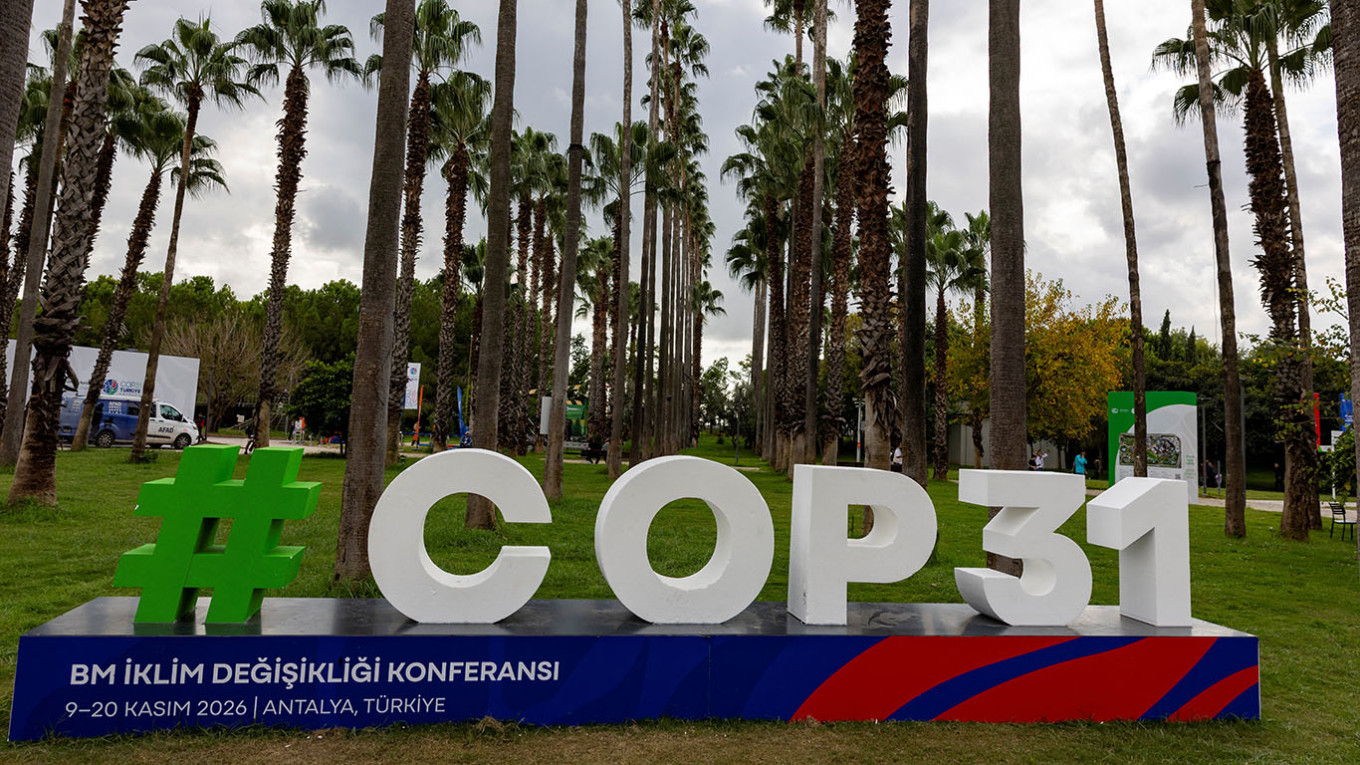
The last time I attended a COP climate summit was in Glasgow, half a year before the full-scale invasion of Ukraine. The situation for the Russian civil society was tense. Repressions were intensifying and many activists had already gone into exile. At the venue, I briefly encountered representatives of the Russian delegation who asked me whether I was happy that they had not done anything to hinder the negotiations that year.
Now it is 2026. As I wrote this article, sitting in the plenary room, where official delegations sit, the room was half empty. There were just a few small, authorized protests outside.
The media is talking about how Russia is falling apart. But from what I can see, the Russian regime has not given up on its ambitions to wield concerns over climate change to line its own pockets. They are not planning to reduce emissions or do anything to fulfill their international obligations.
Their position on what they want and what their ambitions are in these negotiations is quite clear. They want sanctions lifted. They want to return and regain full access to international markets. They want climate negotiations without climate action, without any mention, or at least with watered-down language about the need to reduce our dependence on fossil fuels.
And they are not alone. Just now, a representative of Belarus delivered a speech in which he also complained about the sanctions.
As the world celebrates symbolic victories against Russia and invests all its resources in AI, Russia has its own plan for a future in which the world becomes less dependent on Russian fossil fuels.
On Tuesday, I attended discussions at the Russian pavilion. They focused on Russia’s role in the global food supply. In many areas, Russia ranks first in the global production of grain, sunflower oil and much more. They bragged about their sustainable pork production and the cows they had genetically modified to produce more milk.

At some point, they started talking about navoz ("cow dung") and I lost interest. But what stayed with me was the realization that the world is indeed dependent on Russia in many ways. It is not just about fossil fuels. While Russia destroys Ukrainian agricultural land and pollutes Ukrainian rivers and soil with bombs, it presents itself as a climate champion that wants nothing but good for the world.
In a world where oil prices have soured, this argument might, and should, be taken seriously. Maybe water and grain will become the new oil. In a few years, we might have to survive without coffee and cocoa thanks to a deteriorating climate, made worse by rampant AI expansion. But what Russia has to offer is something much more important for our survival.
In 2019, at my first COP, I met with the Russian president’s climate envoy. It was a surreal meeting in which we talked about the importance of political rights for civil society while they were trying to put pressure on us. Later, during a meeting at their office in Lubyanka, with a representative of the FSB also present, they almost proposed that we cooperate, opening an official office in Russia and perhaps allowing access to resources.
For some reason, our participation was important to them, even though the climate movement in Russia was quite small and only just emerging. Back then, we joked about it. After a few more attempts, they eventually stopped trying to persuade us to behave.
Since then, many things have changed. I was forced into exile. My family was deported and stripped of their only citizenship. Protesting in Russia has become impossible. For reasons unknown, the Fridays For Future Russia page was blocked on Instagra,. Our means of speaking out are becoming increasingly limited.
Meanwhile, Europe is spending enormous resources helping Ukraine while militarizing, introducing many unpopular measures along the way, like reintroducing compulsory military service for young men in Germany.
Russia understands how important it is to spend money on propaganda. I had to raise my own funds just to attend this conference, as civil society has been hit by the deteriorating global economic situation. Sitting near me in the Russian pavilion were young people wearing state delegation badges. I was struck by how most of them were very young women, probably barely 18 years old. Clearly, Moscow is preparing its future generations of climate diplomats — and few people are paying attention
Western institutions are divided by their stance toward the Trump administration and the wars in West Asia, just to name a few things. Meanwhile, Russia is busy ensuring its survival as an imperial power, not just on the battlefield. These issues seem irrelevant to many people across Europe, as well as in Russia.
The Kremlin has a plan. A backup plan and an aggressive strategy to continue its policies. And if necessary, to undermine climate negotiations for everyone, to block them, just as many states have done in the past, Russia will do so along the way.
The world must also have a strategy for dealing with states like Russia. And, unfortunately, Russia is not alone. As expected, the Russian presidential envoy spoke about what he described as a serious crisis in the international climate negotiation process, reiterating the arguments Moscow has been promoting for years. He criticized efforts to phase out fossil fuels and called for removing “political barriers” and sanctions from international energy cooperation, including those limiting Russian access to foreign technology.
Meanwhile, civil society in Russia is barely surviving. Independent environmental organisations, journalists and activists have very limited resources and increasingly few instruments to monitor, investigate or challenge what is actually happening across the country.
What we do know is that Russia continues to destroy nature across its vast territory. Unfortunately, it also retains considerable capacity to cause even greater environmental damage, including in occupied territories and to obstruct future negotiations at the international level. Without international scrutiny and pressure, there is little reason to believe this will change.
A Message from The Moscow Times:
Dear readers,
We are facing unprecedented challenges. Russia's Prosecutor General's Office has designated The Moscow Times as an "undesirable" organization, criminalizing our work and putting our staff at risk of prosecution. This follows our earlier unjust labeling as a "foreign agent."
These actions are direct attempts to silence independent journalism in Russia. The authorities claim our work "discredits the decisions of the Russian leadership." We see things differently: we strive to provide accurate, unbiased reporting on Russia.
We, the journalists of The Moscow Times, refuse to be silenced. But to continue our work, we need your help.
Your support, no matter how small, makes a world of difference. If you can, please support us monthly starting from just $2. It's quick to set up, and every contribution makes a significant impact.
By supporting The Moscow Times, you're defending open, independent journalism in the face of repression. Thank you for standing with us.

Remind me later.