
Starved and exhausted residents from the Russian-controlled town of Oleshky crossed into Ukraine on Saturday in a major return of civilians under the first humanitarian truce of its kind in more than four years of the war.
The six-day local ceasefire in Oleshky was reached after mediation efforts by U.S. first lady Melania Trump and with the Pope's involvement. It is the longest local pause in fighting since Russia's full-scale invasion in 2022.
“As of now, Ukrainian citizens from Oleshky have crossed the Ukrainian border in the Chernihiv region. All of them will receive the assistance they need,” said President Volodymyr Zelensky, thanking the U.S. and Melania Trump for mediation.
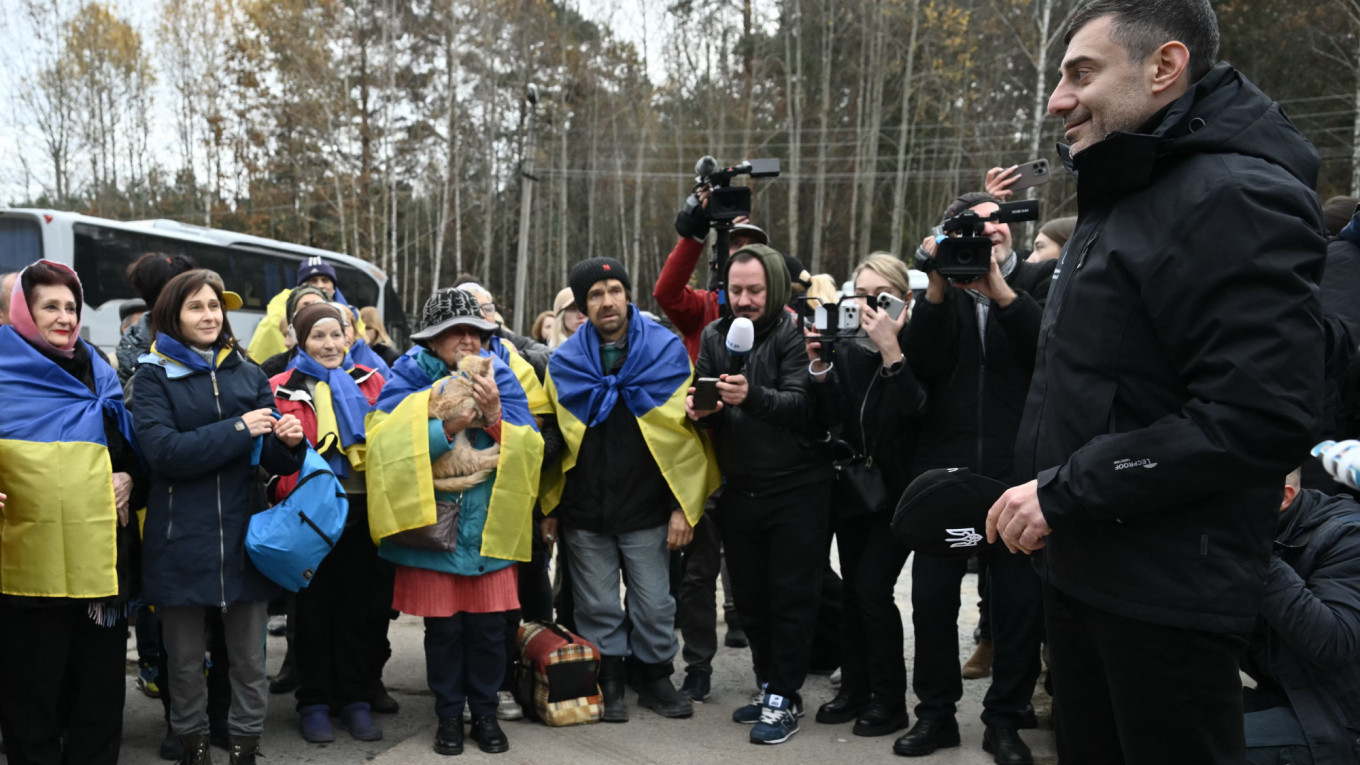
Ukrainian officials greeted the evacuees with posters bearing slogans like “You're not alone” and “We embrace with our hearts.”
One elderly woman said that they had escaped from hell as she exited a bus. She was greeted by another woman wrapped in Ukraine's national blue and yellow flag. Both cried.
To reach Ukrainian-held territory, Oleshky residents had to take a complicated route, traveling by bus via Crimea to the Russian city of Anapa, before flying to Belarus from where they continued on to Ukraine by bus.
A video shared by Ukraine's ombudsman showed dozens of Oleshky residents slowly disembarking from a plane at a Belarusian airfield. Many people were elderly. Some required help walking, and a few were carried on stretchers or in wheelchairs. They carried minimal luggage — only a bag or two. Dogs were unloaded from the plane in cages.
Buses with evacuees cross into Ukraine
As several big buses crossed into Ukraine's northern Chernihiv region from Belarus, many were greeted by relatives. Ambulances lined the street and several large military tents were erected where hot meals, tea and medical aid were provided.
Pet food and water bottles were piled up on several tables.
“We have come a complicated way: from negotiations and agreeing on a ceasefire to delivering humanitarian aid directly to Oleshky and organising the evacuation of civilians,” said Dmytro Lubinets, Ukraine's human rights ombudsman.
The ceasefire has been holding since Tuesday without violations, according to both Ukrainian and Russian officials. It has allowed them to de-mine the roads and bring food, medicines and other supplies into the town.
Supply routes to Oleshky were disrupted by fighting and drones. According to some residents, food deliveries were stopped in May, pushing hundreds of people into starvation.
The ceasefire is set to end on Sunday.
Lubinets said that the oldest returning resident was 94, while the youngest was a child just over one. He gave no exact numbers on how many people returned to Ukraine.
Some residents decided to go to Russia, while others elected to remain in Oleshky, despite the lack of gas, electricity and running water.
Oleshky had a pre-war population of about 24,000. Before the evacuation, an estimated 1,700 remained. The town has been under Russian occupation since the first days of the invasion. It was devastated after the destruction of the Kakhovka Dam in 2023 and the flooding of the nearby areas.
Fighting rages on in other parts of the front
Despite the ceasefire on the southern Kherson front, fighting raged on in other parts of the front. Both Russia and Ukraine also kept up their drone attacks on each other.
Zelensky said that Russia attacked Ukrainian energy infrastructure, hitting electricity substations, thermal power plants and gas infrastructure.
Ukraine's military said that it hit a major Russian producer of missile fuel in the Rostov region.
Kremlin spokesman Dmitry Peskov said that Ukrainian and Russian ombudsmen had a good dialogue and had gradually begun to trust each other as they worked together during the Oleshky ceasefire, Russia's Vedomosti reported.
But the Kremlin said on Friday that it was an isolated situation, which was difficult to extrapolate to the broader peace process.
Negotiators from Ukraine, Russia and the U.S. are due to resume talks in Abu Dhabi in early November after discussions were suspended in February following the outbreak of the war in Iran.
A Message from The Moscow Times:
Dear readers,
We are facing unprecedented challenges. Russia's Prosecutor General's Office has designated The Moscow Times as an "undesirable" organization, criminalizing our work and putting our staff at risk of prosecution. This follows our earlier unjust labeling as a "foreign agent."
These actions are direct attempts to silence independent journalism in Russia. The authorities claim our work "discredits the decisions of the Russian leadership." We see things differently: we strive to provide accurate, unbiased reporting on Russia.
We, the journalists of The Moscow Times, refuse to be silenced. But to continue our work, we need your help.
Your support, no matter how small, makes a world of difference. If you can, please support us monthly starting from just $2. It's quick to set up, and every contribution makes a significant impact.
By supporting The Moscow Times, you're defending open, independent journalism in the face of repression. Thank you for standing with us.

Remind me later.