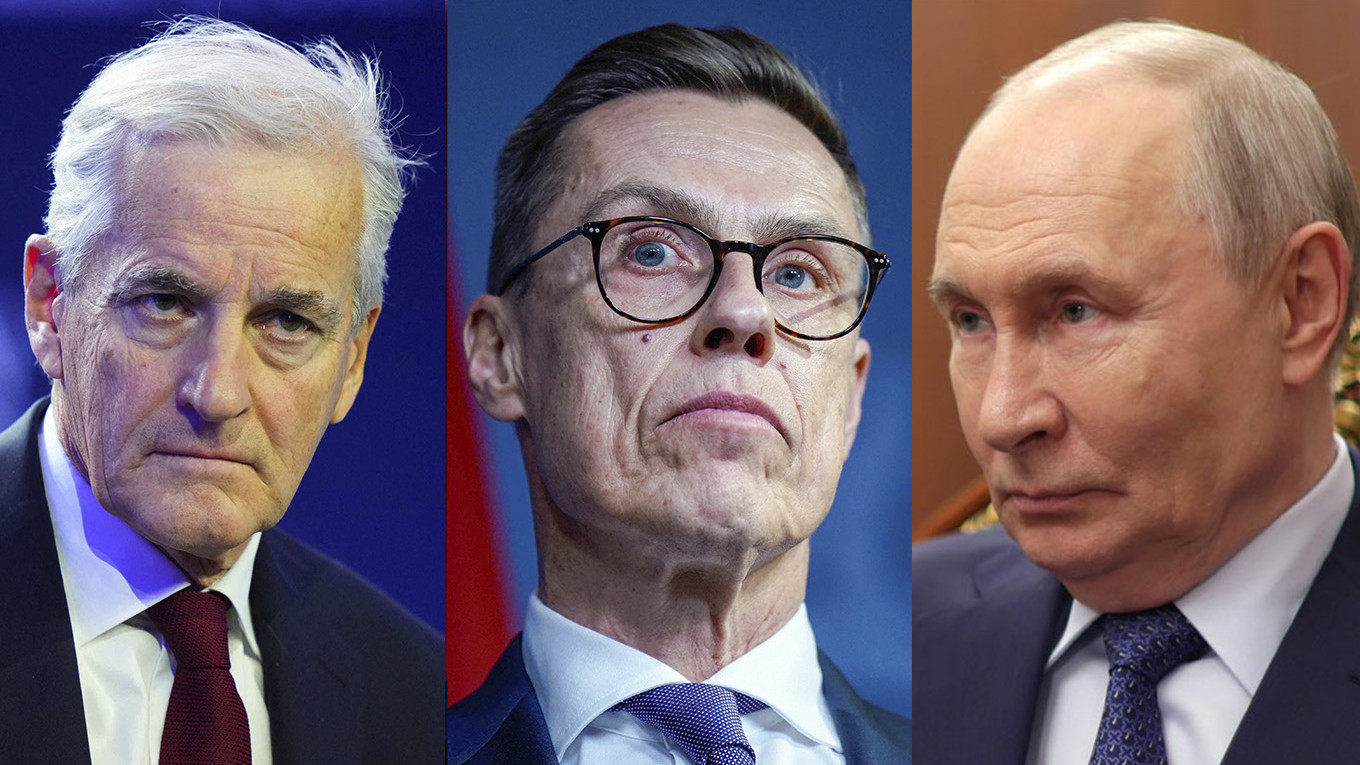
Finnish President Alexander Stubb and Norwegian Prime Minister Jonas Gahr Støre held a phone call with Russian President Vladimir Putin on Tuesday to discuss ongoing efforts to end the war in Ukraine, a move that, while coordinated with Kyiv, some European leaders criticized.
Moscow confirmed the call shortly after officials in Helsinki and Oslo released statements about the conversation, which marks the first time a leader from one of Ukraine’s European allies spoke to Putin since French President Emmanuel Macron’s phone call with the Kremlin chief in July 2025.
Stubb’s office said he and Støre initiated the call in order to “discuss Russia’s war of aggression against Ukraine and the diplomatic efforts to end the war and promote peace and stability in Europe.”
It said the aim of the outreach, made in consultation with Ukraine, was “to convey messages directly regarding future negotiations to help to end the war to President Putin,” adding that it was also “related to the upcoming meetings to be held in Abu Dhabi.”
“In the call we stressed the importance of de-escalation,” Støre’s office said in its statement about the call with Putin.
Both Finland and Norway said their leaders were speaking as representatives of their respective countries and did not speak on behalf of Europe as a whole.
Still, the phone call with Putin was met with criticism from some European leaders.
Danish Prime Minister Mette Frederiksen said she was “very skeptical” of the initiative and did not believe Russia wants peace with Ukraine or Europe.
“I think we should keep Europe together instead of going solo,” Frederiksen said, according to Danish media. “We should stand together and speak with one voice and defend ourselves against Russia.”
In its own statement, the Kremlin said Putin “reiterated the root causes” of his decision to order the full-scale invasion of Ukraine in February 2022.
He also “drew attention to the confrontational policies of EU and NATO member states, which he noted serve to prolong the hostilities,” it added.
Stubb, Støre and Putin discussed security and stability in the Baltic Sea and Northern European regions, the Kremlin’s readout added. The three leaders agreed to maintain direct contact moving forward, it said.
Ukrainian President Volodymyr Zelensky said he spoke to Stubb and Støre following their call with Putin, adding that he was “grateful for the detailed briefing and for their active support for our diplomacy and the peace efforts we are pursuing together with all our partners.”
Zelensky emphasized that the Finnish and Norwegian leaders told Putin that concrete steps needed to be taken in order to de-escalate the war, especially when it comes to attacks on energy infrastructure ahead of winter.
“Russia must stop dragging out the war,” he wrote in a post on social media.
Tuesday’s phone call comes a week after Stubb and Støre met with U.S. special envoy Steve Witkoff and Ukrainian president Volodymyr Zelensky in Oslo. The purpose of the Oslo talks was to mend strained relations between Kyiv and Washington, as well as to seek a new path out of the war.
Witkoff later met with Putin in St. Petersburg to report on progress in efforts to end the conflict. The Kremlin said it is willing to resume U.S.-mediated peace negotiations in Abu Dhabi as soon as next month, though no exact dates have been set.
A Message from The Moscow Times:
Dear readers,
We are facing unprecedented challenges. Russia's Prosecutor General's Office has designated The Moscow Times as an "undesirable" organization, criminalizing our work and putting our staff at risk of prosecution. This follows our earlier unjust labeling as a "foreign agent."
These actions are direct attempts to silence independent journalism in Russia. The authorities claim our work "discredits the decisions of the Russian leadership." We see things differently: we strive to provide accurate, unbiased reporting on Russia.
We, the journalists of The Moscow Times, refuse to be silenced. But to continue our work, we need your help.
Your support, no matter how small, makes a world of difference. If you can, please support us monthly starting from just $2. It's quick to set up, and every contribution makes a significant impact.
By supporting The Moscow Times, you're defending open, independent journalism in the face of repression. Thank you for standing with us.

Remind me later.