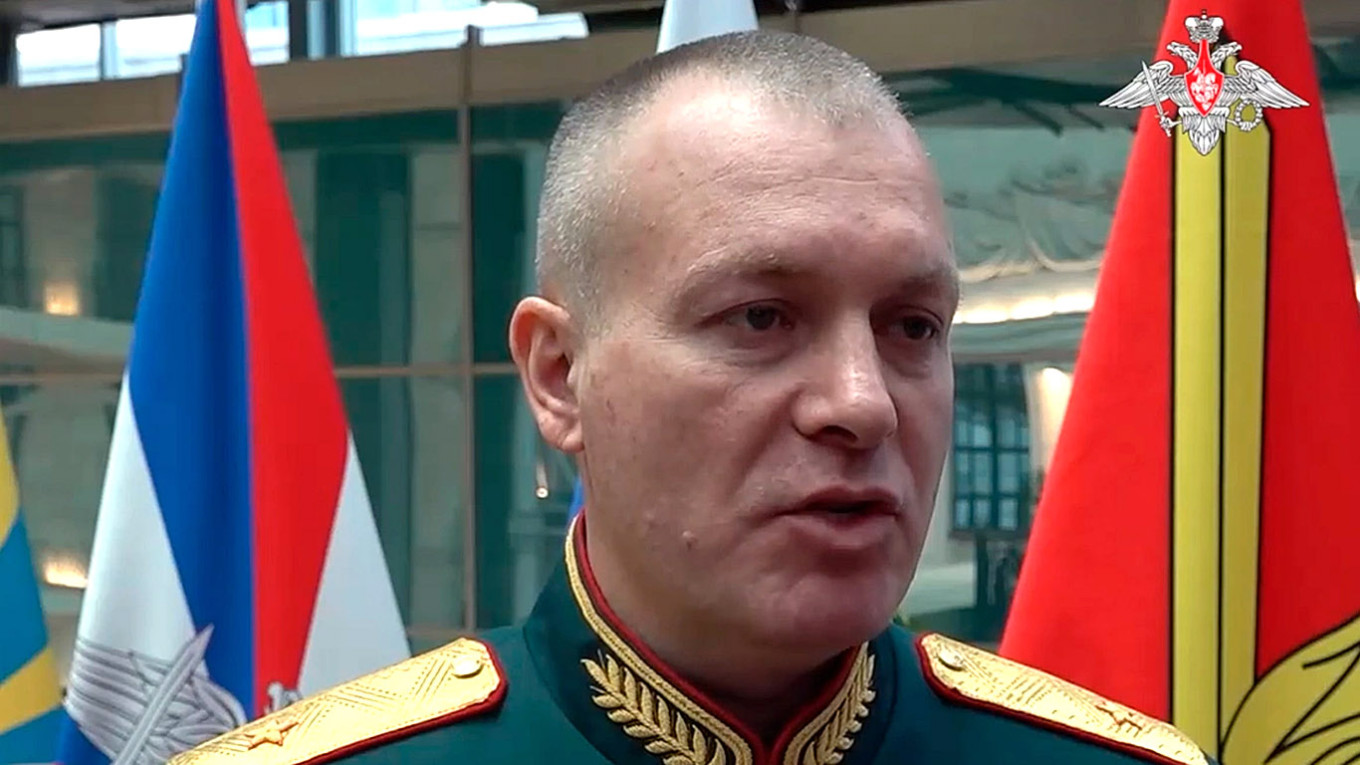
A military commander who President Vladimir Putin recently awarded Russia’s highest state honor for the capture of the eastern Ukrainian city of Kostiantynivka has died, Russian and Ukrainian military officials said Wednesday.
Major General Apti Alaudinov, who serves as serves as deputy chief of the Defense Ministry’s ideological arm and commander of the Akhmat special forces, said Major General Anton Grunis “passed on to another world” in a short post on Telegram.
“He left us as a hero who carried out his sacred duty,” Alaudinov said without specifying when Grunis died or the circumstances of his death.
Ukraine’s Unmanned Systems Forces commander, Robert “Madyar” Brovdi, later claimed that Grunis was “eliminated” in a nighttime raid in the eastern Donetsk region on Sept. 12.
The Moscow Times could not independently verify the claim.
Grunis commanded the Russian Armed Forces’ 4th Separate Guards Motor Rifle Brigade, which has played a key role in Russia’s offensive in the Donetsk region.
In July, Grunis personally briefed Putin on the capture of Kostiantynivka, one of four heavily fortified cities that make up Ukraine's so-called “fortress belt” in Donetsk. Earlier, Grunis boasted that his troops had “sliced up the city like a pie” by outflanking Ukrainian defense lines along local reservoirs.
Ukraine has denied claims that Russia fully captured Kostiantynivka. According to the U.S.-based Institute for the Study of War, Russian forces control parts of the city, but Ukrainian forces continue to carry out counteroffensives in the area.
Putin awarded Grunis the Hero of Russia medal in August.
In 2023, the Russian president had praised him as a commander “with a Lithuanian surname, born in Kazan, who fights brilliantly.”
A Message from The Moscow Times:
Dear readers,
We are facing unprecedented challenges. Russia's Prosecutor General's Office has designated The Moscow Times as an "undesirable" organization, criminalizing our work and putting our staff at risk of prosecution. This follows our earlier unjust labeling as a "foreign agent."
These actions are direct attempts to silence independent journalism in Russia. The authorities claim our work "discredits the decisions of the Russian leadership." We see things differently: we strive to provide accurate, unbiased reporting on Russia.
We, the journalists of The Moscow Times, refuse to be silenced. But to continue our work, we need your help.
Your support, no matter how small, makes a world of difference. If you can, please support us monthly starting from just $2. It's quick to set up, and every contribution makes a significant impact.
By supporting The Moscow Times, you're defending open, independent journalism in the face of repression. Thank you for standing with us.

Remind me later.